Career Development
How to Answer "Tell Me About Yourself" in an Interview

How to Answer "Tell Me About Yourself" in an Interview
Your best answer is short, job-focused, and built around three parts: what I do now, what led me here, and why I want this role. In most interviews, I should keep it to 60 to 90 seconds, include at least one number or result, and end with a clear link to the company.
Here’s the whole idea in plain English:
- Start with the present: my current role, my scope, and one strong result
- Add the past: one or two career moves that show why I fit
- End with the future: why this company and this job make sense for me
- Match the job description: use the same job title and 2–3 hard skills
- Skip the fluff: no life story, no resume walk-through, no long tool list
- Practice out loud: aim for about 130–150 words per minute
- For technical interviews: keep the intro closer to 45 seconds so there’s time for deeper discussion
What interviewers are listening for is simple: Can I explain my background clearly? Can I show fit with proof? Do I sound focused on this role? If I can do that with one or two specific wins - like cutting on-call issues, handling 50% more throughput, or driving pipeline growth - my answer does its job fast.
A good answer usually includes these five things:
- My current role
- A relevant result
- Past experience tied to the job
- Keywords from the job post
- A clear reason for applying
Before I use my answer, I’d do one quick check: Is it short, specific, and tailored? If yes, I’m in good shape.
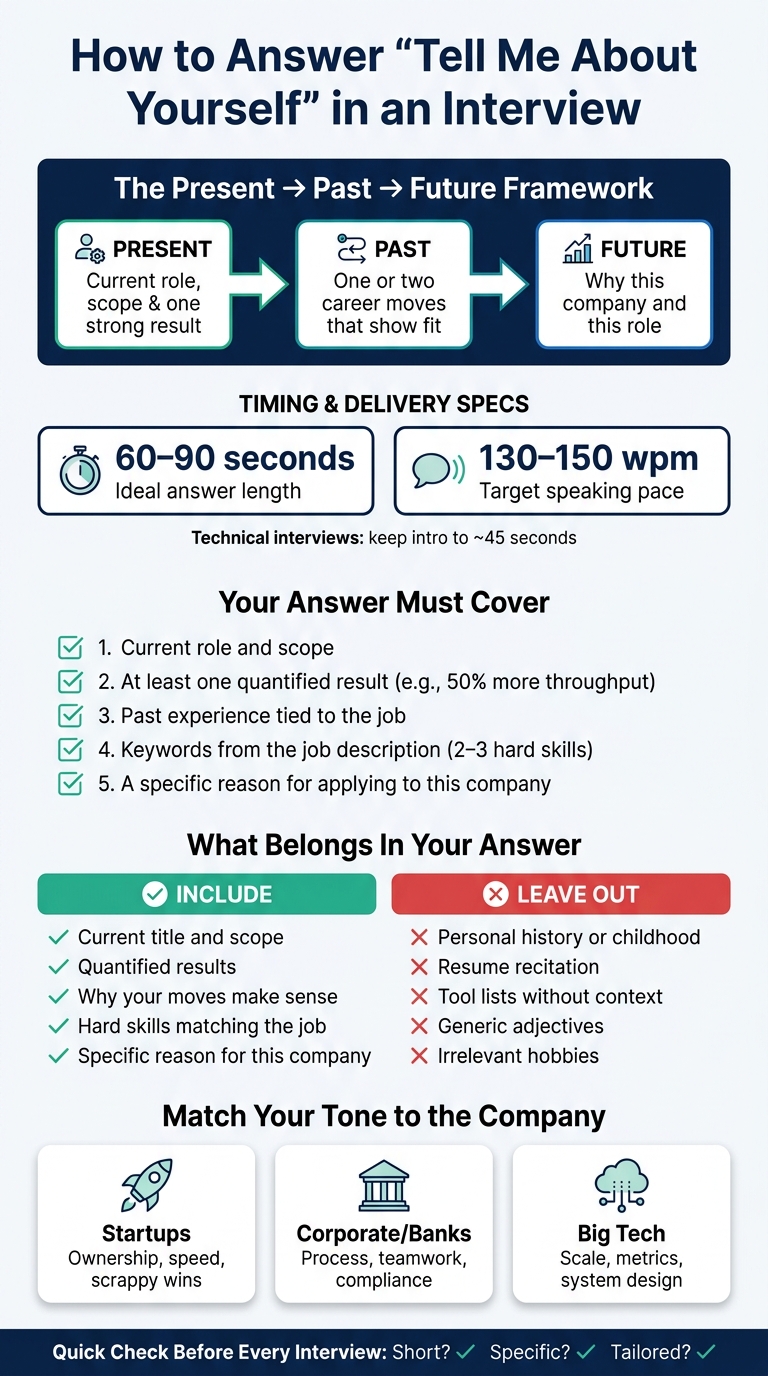
How to Answer 'Tell Me About Yourself' in an Interview
Answering “Tell Me About Yourself” in an Interview: Step-by-Step Guide
sbb-itb-04479f0
Use a simple structure: Present, Past, Future
Think of this as a tight summary, not a run-through of your whole resume. The Present-Past-Future framework gives you a simple way to keep your answer focused and easy for the interviewer to follow. It also helps you stay clear and relevant. Each part answers one question: what you do now, why you're a fit, and why you want this role.
Present: Start with your current role, scope, and one strong result
Start with who you are at work right now. Share your current title, the scope of your work, and one clear result. The point isn't to list job duties. It's to show the kind of impact you make.
Instead of saying, "I'm a backend engineer", try this:
"I'm a backend engineer who redesigned a payment ingestion pipeline to handle 50% more throughput during peak traffic."
In one line, that tells the interviewer your level, your area, and what you've done. If you're in a technical role, mention your main stack too so they can place you in the right setting. Then move into the small set of experiences that explain how you got here.
Past: Pull in only the experience that explains why you are qualified
Choose one or two career moments that create a clear line to where you are today. Focus on why each move mattered, not just what changed. For example, saying, "I joined a larger company to see what payments infrastructure looks like at four orders of magnitude more volume" shows intent. And that's exactly the kind of self-awareness interviewers want to hear.
Leave out unrelated roles and side details that don't support this job. Keep it tight. Then connect that path back to this role.
Future: Connect your next step directly to this role and company
Your last move should act like a bridge from your path to this specific role. Don't close with something vague like, "I'm looking for my next challenge." Be specific instead. Mention a product area, a technical problem the team is working on, a recent launch, or an engineering blog post that caught your attention.
For example:
"I've been following your shift toward event-driven architecture, and given my background scaling distributed systems, this role feels like a natural next step."
That kind of ending shows you've done your homework. It also makes it clear you're not just looking for a job. You're interested in this one. And that often sets up the interviewer's next question nicely.
How to tailor the answer to the job and your situation
The framework helps, but you still need to shape it to the role in front of you. Specific details are what make this answer land. The very same answer can sound sharp in one interview and off-target in another, depending on what the company needs.
Match your answer to the job description and company context
Before the interview, read the job description closely and pull out the top 3–4 skills or outcomes the role calls for. Then look at your "Past" section and make sure it lines up with those points in a direct way. If the posting leans hard on collaboration or system reliability, a feature-focused story alone may not carry enough weight. In your closing line, tie your answer back to the company's recent work [1][2].
Tone matters too. Different companies listen for different signals.
- At startups, lean into ownership, speed, and scrappy projects.
- In corporate or bank settings, put more weight on process, teamwork, compliance, and stakeholder management.
- At big tech companies, lead with scale, impact, system design, optimization, and clear metrics.
How technical candidates should summarize depth without overexplaining
Technical candidates need one extra rule: show depth without turning your answer into a list of tools.
Mention tools only when they help explain the result. Instead of saying you work with Kubernetes, say you used it to auto-scale a billing service that had been going down during peak load. That tells a much better story. It shows the business problem, the constraint, and the outcome - whether that was lower latency, cost savings, or better throughput.
For senior roles, shift the focus toward ownership and judgment. What calls did you make? How did those calls affect other teams or downstream systems? That's what interviewers at that level are listening for.
How career changers and returners should frame transitions with confidence
Nonlinear backgrounds need the same discipline: connect the past to the role, then move forward.
Make the shift sound intentional. If you're changing careers, use the "Past" section to draw a straight line between your earlier work and where you're headed now. A teacher moving into corporate EdTech, for example, might focus on curriculum design and mentoring instead of classroom management. The point is to highlight what transfers, not what changed.
If you're returning after a gap, lead with your professional identity and your most relevant win. Then point to any recent upskilling, certifications, freelance work, or personal projects that show you're ready now. Don't open with the gap, and don't apologize for it if it comes up. Keep that part short, then move the conversation ahead.
What to include, what to leave out, and the mistakes that hurt strong candidates
Include specific strengths, relevant results, and a clear reason for this role
Use the Present-Past-Future structure to decide what belongs in your answer. It helps you show fit, impact, and direction without rambling.
Start with your current role and scope. Then add one quantified result, the hard skills that match the job, and a clear reason you want this role. Done well, your answer sets up the next question instead of forcing the interviewer to dig for the good stuff.
Leave out personal history, resume recitation, and jargon and tool lists
Don’t walk through your resume line by line. Skip unrelated personal details too. If you work in a technical role, avoid dumping every tool you’ve touched. A long stack list with no business context tells the interviewer almost nothing.
Once you know what should stay, the next move is simple: cut what pulls attention away.
| Include | Leave Out |
|---|---|
| Current title and scope | Birthplace, family, or childhood |
| Quantified results (percentages, revenue, scale) | Line-by-line resume recitation |
| Why your moves make sense | Jargon and tool lists without business context |
| Specific reason for applying to this company | Irrelevant hobbies or personal interests |
| Hard skills that match the job description | Generic adjectives |
The most common mistakes: too long, too vague, or not tailored
Aim for 60–90 seconds. Anything longer starts to drag, and once you go past 90 seconds, attention can drop fast.
Another common problem is vagueness. Saying you’re “results-driven” or “passionate about technology” without a number, project, or example behind it makes your answer sound generic. Specifics make people remember you. General claims do the opposite.
The third issue is using the same answer for every employer. That can sound lazy or unprepared. Shape the “Past” section around the role and company culture, and make your closing line specific to that company’s work or challenges.
| Aspect | Weak Answer | Strong Answer |
|---|---|---|
| Starting point | Childhood, hometown, or oldest degree | Current role and most recent relevant impact |
| Structure | Chronological resume crawl | Present → Past → Future arc |
| Content | Personal trivia or generic adjectives | 1–2 quantified wins tied to the role |
| Technical detail | Tool list with no context | Depth translated into business outcomes |
| Ending | Trails off with "So yeah, that's me" | Clear bridge to the company's specific needs |
| Length | Too long | 60–90 seconds |
With the content trimmed down, the next step is practice until it sounds like you - not a script.
Put it into practice: sample formulas, rehearsal, and final takeaways
Short sample answer formulas for different backgrounds
Use these templates to turn the framework into a natural answer. The point isn't to memorize a script. It's to shape it around your experience by swapping in your own numbers, tools, and company details.
| Background | Present | Past | Future |
|---|---|---|---|
| Software Engineer | "I'm a backend engineer at a fintech startup, where I own infrastructure that processes roughly 2 million transactions a day." | "Before this, I led a monolith-to-microservices migration that improved deployment speed and reduced on-call issues." | "I'm drawn to your team because your event-driven architecture work is exactly the kind of problem space I want to deepen my experience in." |
| Career Changer (Teacher → L&D) | "Right now I'm a high school English teacher with experience in curriculum design and working across departments." | "Over five years, I've built facilitation skills, stakeholder coordination, and data-driven course iteration - skills that translate directly into instructional design." | "I'm making this move deliberately, and I'd love to bring that background to the instructional design work your L&D team is hiring for." |
| Returner After a Gap | "I'm a marketing professional with several years of experience leading demand generation for B2B SaaS companies." | "My strongest work has been scaling a content program and driving pipeline growth. Since then, I've completed a Google Analytics certification and freelanced on two demand gen campaigns to stay current." | "I'm ready to bring that same focus to a team like yours, and I'm excited about the challenges in this role." |
Lead with your professional identity. Bring up the gap only if you're asked. These examples work best as a simple guide for role, proof, and fit.
How to rehearse until the answer sounds natural, not memorized
Practice until the answer feels loose and comfortable, not like you're reading lines from a play.
After the content is in good shape, say it out loud. Write the full version first, then cut it down to three or four key data points for each part. Record yourself on video or as a voice note, then listen back once. One round of recording and playback is often worth ten silent run-throughs [1]. Aim for about 130–150 words per minute [1][3].
When that version starts to feel easy, make small tweaks for different interview settings: one for a recruiter, one for a hiring manager, and one for a technical panel. In technical interviews, keep the intro to around 45 seconds so there's still time for the deeper part of the conversation [4]. Mock interviews can also help tighten both your message and your delivery before the real thing.
Key points to carry into every interview
A strong answer to "Tell me about yourself" usually does the same five jobs. It explains what you do now, shows why you're qualified with selected proof, uses the right keywords, includes at least one number, and ends with a clear reason you want this role.
Use this check before each interview.
| Checklist | Question to Ask Yourself |
|---|---|
| Duration | Does it land between 60 and 90 seconds? |
| Structure | Does it follow Present → Past → Future? |
| Keywords | Does it use the exact job title and 2–3 hard skills from the job description? |
| Impact | Is there at least one quantified result? |
| Company Fit | Does the final sentence name the company and a specific reason for applying? |
| Delivery | Have you recorded it to catch filler words and trailing endings? |
If you can check every box, your answer is ready. If one row is empty, that's your next fix.
FAQs
What if I have little experience?
If you’re early in your career, lean on academic work, internships, projects, or volunteer roles that show what you can do and where you’re headed.
Don’t just walk through your resume line by line. Point to specific wins instead - like a side project you built, tools you used, or customer problems you helped solve. That’s what gives people a clear picture of your skills.
If your background is nontraditional, don’t treat it like a weakness. Present it as the path that built the abilities you bring now.
How do I answer if I’m changing careers?
Start with who you are now, then walk back to where you came from and where you’re headed. That Present-Past-Future flow helps your career change read like a clear story instead of a random jump.
In the present, name your current professional identity in a direct way. Then connect it to the kind of work you want to do next. This gives the reader a frame right away.
Next, move into the past. Pull out the parts of your background that matter most for the new role. Focus on transferable skills, key lessons, and the moments that shaped your shift. The point isn’t to list every job. It’s to show that your past work built the judgment, habits, and skills you’ll bring into this next chapter.
Then point to the future. Explain why you’re making this move on purpose. Be clear about what drew you to this path, what you’ve done to prepare, and why this role makes sense for where you want to grow. That’s what turns a pivot into a logical next step.
Keep the thread tied to the company’s needs. Don’t just say, “I want a new challenge.” Show how your background lines up with what they need help with. If you’ve led projects, worked across teams, solved messy problems, or learned new tools fast, spell that out in plain English. Those are the bridges between your old field and the new one.
A good version sounds like this:
I’m currently a project coordinator with a strong focus on cross-team communication and process improvement. Earlier in my career, I worked in operations, where I learned how to manage deadlines, spot bottlenecks, and keep people aligned under pressure. Over time, I found myself drawn more and more to product work, especially the mix of user needs, team coordination, and problem-solving. That shift led me to build product skills more directly, and now I’m looking for a role where I can bring my operations background into a product environment in a way that helps the company move faster and make better decisions.
That kind of answer works because it feels intentional. It shows where you are, what you’ve built, and why this move makes sense now.
Should I mention a work gap?
Don’t bring up a work gap in your first answer. Keep the focus on your work story, key wins, and why you fit the role, not on your job timeline.
If the interviewer asks about it later, give a brief, honest answer. Then shift the conversation to what you learned, what you got done, and what you can bring to the job.
Related Articles
Ready to transform your job search?
Book a free intro call and get a recruiter's honest take on your career strategy.
Book a Call