Career Development
Career Change Checklist: 10 Steps Before You Make the Move
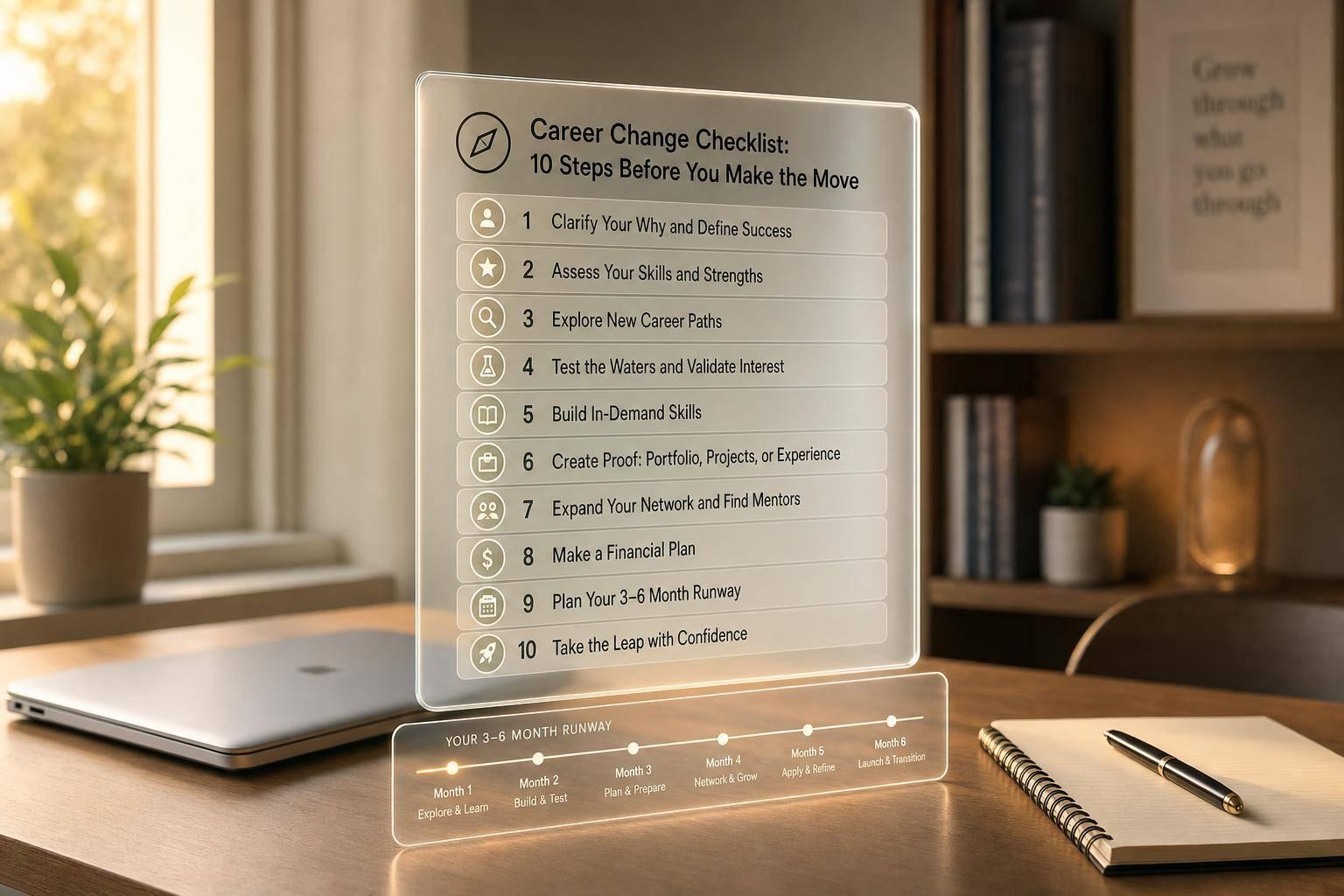
Career Change Checklist: 10 Steps Before You Make the Move
Changing careers is common, but quitting too early can cost you time and money. About 50% of U.S. workers have changed careers, plan to, or are thinking about it, and most career shifts take 6 to 18 months.
Before I resign, I’d make sure I can answer three things:
- Am I leaving a bad job or the wrong career?
- Can I point to skills that fit the new role?
- Do I have enough savings to handle a gap in income?
This checklist walks through 10 steps in a simple order:
- Check why I want out
- List the skills I can carry over
- Look at a small set of target roles
- Test the work before I commit
- Find the main gaps and make a learning plan
- Rewrite my resume and LinkedIn for the new path
- Put the move on a timeline
- Compare pay, benefits, and tradeoffs
- Check savings, costs, and timing
- Decide whether to move now, take a bridge step, or wait
The main point is simple: I should treat a career change like a project, not an escape. If I can name a few target roles, show proof of fit, and cover 3 to 6 months of basic expenses, I’m in a much better spot to make the move.
| What to check first | What good looks like |
|---|---|
| Reason for change | I know if it’s a job problem or a career problem |
| Role fit | I can name 2–3 target roles and explain why they fit |
| Skill match | I meet much of the core role needs and know my gaps |
| Proof | I have sample work, test projects, or feedback from people in the field |
| Money | I can cover at least 3–6 months of basic costs |
| Timing | I know how bonuses, insurance, and life events affect my exit date |
If I can’t check those boxes yet, that doesn’t mean “don’t do it.” It means don’t rush it.
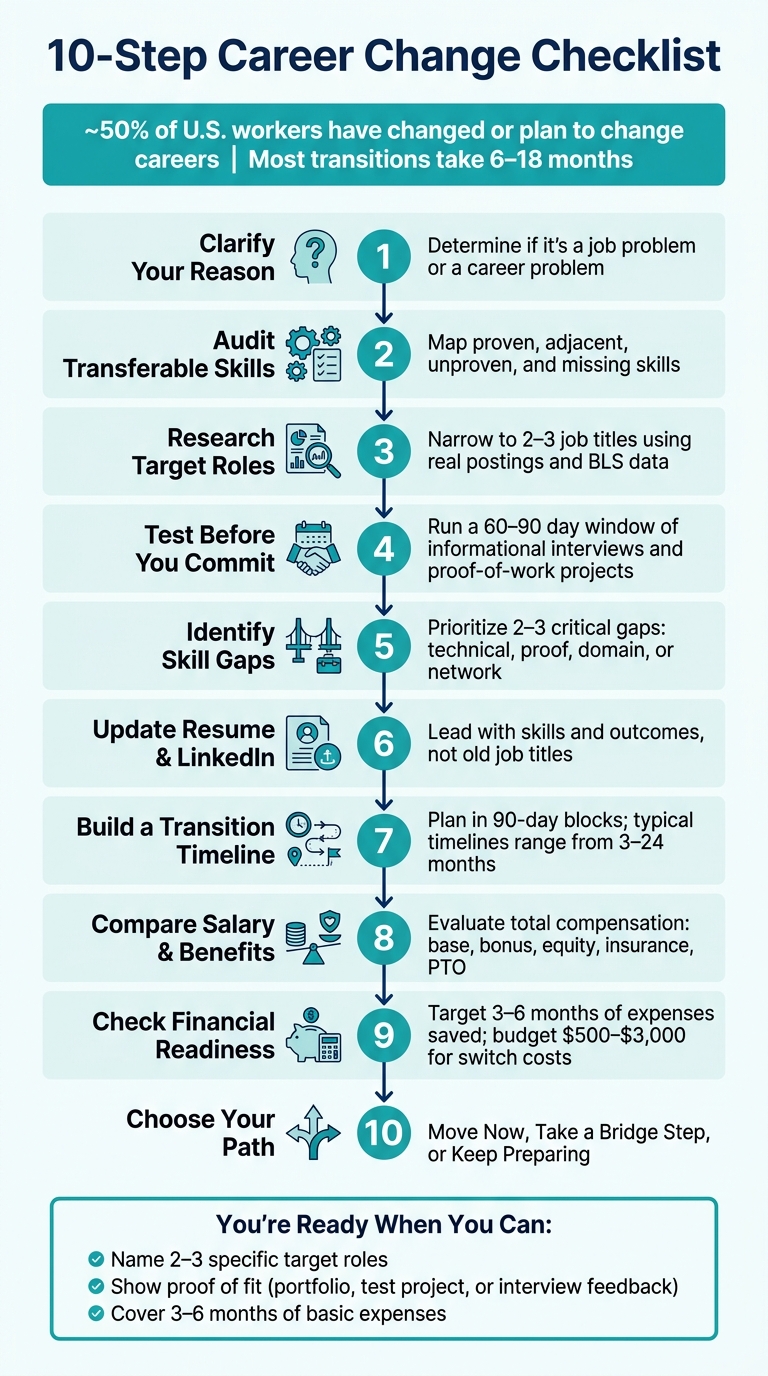
10-Step Career Change Checklist: From Doubt to Decision
How To Make A Career Change (Step-By-Step Guide)
sbb-itb-04479f0
1. Clarify Why You Want to Change Careers
Before you touch your resume or start digging into new fields, answer one blunt question: are you reacting to your current job, or do you actually want a different line of work?
That distinction matters more than most people think.
A bad manager or a toxic team usually points to a job issue. Losing interest in the work itself points to a career issue. Career strategist Katharine Gallagher says it well:
"A lot of people change jobs when what they actually need is to change careers. Others change careers when what they needed was a better employer." [3]
One simple way to sort this out is an Away/Toward check. Write down what you're leaving behind, then write down what you're moving toward. If the away from side comes easily but the toward side feels fuzzy, you're probably trying to get out, not make a clear choice.
If burnout is behind this decision, hit pause before you resign. Exhaustion can warp your judgment and make any exit look like the right one.
This table can help you tell the difference:
| Factor | Job Dissatisfaction | Career Mismatch |
|---|---|---|
| Core Tasks | You enjoy the daily work but hate the context | You dislike the work no matter where you do it |
| Main Stressor | A specific manager, team, or company culture | The industry's direction or the basic nature of the work |
| Risk Level | Low to moderate; uses your current network | Moderate to high; needs reskilling |
If you still like the work but can't stand the setting, a job change is often the faster, lower-risk move. If the work itself no longer fits, go to Step 2 and review the skills you can carry with you.
2. Audit Your Transferable Skills and Strengths
Once you've decided a career change makes sense, the next step is to take an honest look at what you already bring to the table.
Start with 10 to 15 job postings for roles you want. Go through them line by line and mark the skills, tools, and job duties that keep showing up. Those repeats usually tell you what the role actually asks for day to day. This helps you see whether the move makes sense right now or whether you need more prep first.
Use that list to sort your skills into clear buckets:
| Skill Level | What It Means | What To Do |
|---|---|---|
| Proven | Skills with documented results and clear relevance | Highlight in your resume summary and interview stories |
| Adjacent, needs refresh | Skills used in a different context or needing a refresh | Reframe using target industry vocabulary; do a quick review |
| Unproven | Skills you can perform but lack visible evidence | Build a portfolio piece, volunteer, or take a freelance project |
| Missing | Tools or tasks you've never used | Pursue structured learning, such as a certification or bootcamp, plus a project |
Then reframe your past work in the language of the target role. Same skill, different label, different field. That shift matters more than most people think.
If a skill falls into the Unproven bucket, don't jump straight into another course. Build proof first. A small freelance project, volunteer work, or even a self-made case study can give you evidence you can point to [9]. As a general benchmark, if you can match at least 60% of a target role's requirements to real proof from your past work, your background is credibly transferable [5].
Once you know what carries over and what still needs work, it's much easier to narrow down the roles and industries worth your time.
3. Research Specific Roles and Target Industries
Start by turning your transferable skills into a short list of target roles. Keep it tight: pick 2 or 3 job titles to compare, then use actual job postings to see how those titles show up in the market.
Review 10 to 20 real U.S. job postings for each title. Look for the patterns that keep coming up, including:
- repeat responsibilities
- common tools or software
- licenses, degrees, or other credentials
As career strategist Katharine Gallagher puts it:
"Job titles rarely transfer cleanly. Skills do." [3]
That idea matters. A title might change from one company to the next, but the work often overlaps. So don’t get stuck on labels. Focus on what employers keep asking for.
You’ll also want to check whether the field leans more toward certifications or portfolio proof. Then look at the stated seniority level. If most openings ask for more experience than you have, you may need a bridge role first.
Use BLS and O*NET to check pay and job growth for each role. [4] That gives you a clearer picture of which paths make sense on paper, not just in theory.
The point here isn’t to study the whole market. It’s to narrow your options to the few roles worth testing next. End this step with a ranked shortlist of 2 or 3 roles. Step 4 is where you test fit.
4. Test the Career Change Before You Commit
Use this step to check the work before you resign. Give yourself a 60- to 90-day testing window before making a full move. Use the roles you shortlisted in Step 3 as the focus of these tests.
Job postings only tell part of the story. You need direct exposure to see what the work is actually like. For each shortlisted role, talk to 3–5 people who do that job now. Ask simple, direct questions: What does a typical Tuesday look like? What skills do you use that don't show up in the job description? If you can, shadow someone in the role so you can watch the routine parts of the job in context. [2][8] Treat these conversations as a fit check, not a sales pitch for a job.
Then test fit with one proof-of-work sample in the role you're exploring. That could be a case study, a GitHub repo, a freelance project, a volunteer role, or an internal stretch task. Pick one project that looks like the kind of work you want to do next. If your current employer has related projects or stretch assignments, put your hand up for those too. [2][11]
After each test, write down what you found in a simple three-part framework:
| Framework Component | What to Track |
|---|---|
| What I Learned | Daily realities, required tools, and proof-of-work outcomes [4][6] |
| What Shifted | Shifts in your energy, interest level, or how you see the target role [1][2] |
| Open Questions | Gaps in knowledge, lifestyle fit concerns, and anything else still unresolved [2][1] |
Use what you learn here to spot the skill gaps you need to close next.
5. Identify Skill Gaps and Build a Learning Plan
Your testing window from Step 4 probably exposed a few weak spots. Now it’s time to sort them out.
Go back to the job postings you reviewed and count the requirements that show up again and again. That helps you separate what’s required from what’s just preferred. Then use your test results to rank the gaps that matter most.[11]
One thing trips people up here: a credibility gap is not the same as a skill gap.
You may already know how to do the work. But if you don’t have a portfolio piece, project, or sample that shows it, hiring managers have nothing to judge. And that’s the point. Hiring managers respond to proof, not effort. Use your test project to close proof gaps, not just skill gaps.
Keep your focus tight. Aim at 2–3 critical gaps, max. If you try to fix everything at once, you spread yourself too thin.[7][2]
Use the table below to sort what you found and decide what to tackle first:
| Gap Type | How to Spot It | Priority Action |
|---|---|---|
| Technical/Tool Gap | Shows up repeatedly in job descriptions as required. | Take the course or certification employers name. |
| Proof Gap | You get interviews, but no offers; feedback mentions a lack of experience. | Build a portfolio project, case study, or freelance sample. |
| Domain/Industry Gap | Informational interviews reveal unfamiliarity with industry jargon or trends. | Industry reading and networking. |
| Network Gap | Applications stall in ATS and you don't have internal referrals. | Strategic outreach to former colleagues and new industry peers. |
From there, pick the smallest set of actions that closes the biggest gaps.
In plain English: start with the tools that give you the most proof for the least effort. That usually means hands-on projects and mentorship first. Save certifications for cases where employers clearly ask for them.
Then take what you learned from this gap list and use it to rewrite your resume and LinkedIn for the new direction.
6. Update Your Resume and LinkedIn for the New Direction
Now it’s time to turn the skills and gaps you mapped out into a resume and LinkedIn profile that fit your target role.
One mistake career changers make all the time is leading with their old job title instead of the skills an employer is looking for. Your resume summary and LinkedIn headline should focus on what you can do and the problems you can help fix.
Rewrite your bullets to show outcomes, not just tasks. Here’s the difference:
| Before | After |
|---|---|
| "Taught 5th-grade math and developed lesson plans." | "Designed instructional curricula and managed stakeholder learning outcomes." |
Once you shift the wording on your resume, carry that same angle into LinkedIn. Use your LinkedIn About section to clearly name your target role, connect your past work to that direction, and spell out the problem you now solve. The goal is to make the move feel natural, not random.
Use the language from your target job postings to line up your profile with the roles you want. Go back to the job descriptions you collected in Step 3, then reuse the terms that show up again and again in your summary, bullets, and skills section.
With your profile lined up, build a transition timeline that turns interest into action.
7. Build a Transition Plan With a Clear Timeline
Now that your resume and LinkedIn are up to date, put your career change on a timeline.
Use the fit tests and gap list from the earlier steps to decide how fast you should move. Some career changes happen in a few months. Bigger pivots usually take a year or longer.
| Transition Type | Example | Typical Timeline |
|---|---|---|
| Adjacent field, similar skills | Marketing → Product Management | 3–6 months |
| New field, transferable skills | Teaching → UX Design | 6–9 months |
| New field, new skills | Retail → Software Engineering | 9–18 months |
| Complete reinvention | Manufacturing → Cybersecurity | 12–24 months |
Use this table as a reality check. If the skills gap is bigger, you’ll likely need more time or a bridge role.
Plan in 90-day blocks. In the first 30 days, confirm your direction and map out money-based decision points. During days 31–60, test the path. Narrow your focus to one or two target roles, start informational interviews, and tailor your resume and LinkedIn. By day 90, pick one direction: start applying, take a bridge role, or keep building. That checkpoint should match what you learned from your role tests and skill audit.
A bridge role is worth deciding on early. It’s a job that gets you closer to your target role without requiring you to already be there. This route makes sense if your skills gap is large, your savings are thin, or you need more industry proof before hiring managers take your application seriously. If most of the required skills already line up, go for a direct switch. If they don’t, use a bridge role. Your transition has to match your money, time, location, and energy.
Build a transition dashboard and review it at three levels: weekly for actions like research and networking, monthly for patterns and feedback, and quarterly for major stay/go decisions [1]. Track things like:
- runway remaining
- target roles
- networking conversations
- applications versus responses
Those numbers show whether you’re on track or whether you need to adjust before you’re forced into a decision.
Once your timeline is set, compare pay, benefits, and market tradeoffs.
8. Compare Salary, Benefits, and Market Tradeoffs
Once you know the role fits, price the move before you apply. Don’t look at base salary alone. Look at total compensation: bonus, equity, retirement match, health insurance, PTO, flexibility, and workload.
Start by listing your current package in plain terms:
- Salary
- Bonus
- Equity
- Employer-paid health premiums
- 401(k) match
- PTO value
Then stack that against the target role. A job with a higher base salary can still be a worse deal if the benefits are weaker, the schedule is less flexible, or the workload is heavier.
Use the BLS Occupational Outlook Handbook and Glassdoor to sanity-check pay ranges for your target role [8][10]. That gives you a better read on what entry-level or mid-level pay looks like in the market. And yes, a lower starting salary can still be a smart move if the field has better long-term upside [10][1][3].
| Compensation Component | Current Role | Target Role (Entry/Mid) | Long-Term Potential (5+ Years) |
|---|---|---|---|
| Base Salary | |||
| Annual Bonus | |||
| Equity/Stock | |||
| Retirement Match | |||
| Health Insurance | |||
| Paid Time Off | |||
| Flexibility | |||
| Earning Potential |
Timing matters too. If you’re close to a bonus payout or an equity vesting date, leaving early can cost you actual dollars [3]. It’s one of those details people brush past until they do the math.
Also check for benefit waiting periods. Then add any one-time switch costs, like certification, equipment, or coaching fees [1][4]. Use that first-year total to judge what the move will actually cost.
That comparison helps you decide whether the move makes sense, even if there’s a short-term dip, before you look at your financial runway.
9. Check Financial Readiness and Timing
After you compare pay, the next step is simple: can you cover the gap before your next job starts? A lot of career changers get this part wrong. They leave too early, then end up taking the first offer that comes along.
Start with your runway. Six months of minimum monthly expenses in savings is the safer target; three months is the bare minimum [4]. First, figure out your monthly floor:
- Rent or mortgage
- Utilities
- Groceries
- Minimum debt payments
- Health insurance
If you leave your job, make sure you price out your own health insurance too. That one catches people off guard all the time. A solid cash cushion gives you room to make a smart move instead of a panicked one.
Once you know that monthly number, add your one-time switch costs and stack them against your runway. A structured career change usually costs $500–$3,000 for certifications and courses [4]. You may also need to budget for career coaching, interview travel, and a possible move [1]. One smart stress test: live on your target salary for two to three months before you resign [2].
Timing matters just as much as savings. Check payout dates before you pick your last day. Then look at major life events - caregiving duties, health needs, parenting, or relocation [1][2] - and ask whether they fit your plan or throw it off. If a big life change is around the corner, waiting may be the better call. Set a decision date now, and be clear about what would make you pause [1][2].
Your runway should also match the kind of move you're making. An adjacent shift may need less time. A full career reset usually needs more. Set your deadline before pressure sets it for you.
10. Decide Your Next Step: Move Now, Bridge, or Keep Preparing
Use your runway, role tests, and market response to choose one path. Look at what your tests showed, where the gaps are, and what your finances can handle. Then choose from three options:
| Path | When It Fits | Typical Timeline |
|---|---|---|
| Move Now | High clarity, can name 3 specific job titles, 3–6 months of savings, roughly 70% of the core requirements met, and screening calls or interviews already happening | 3–6 months [4] |
| Bridge Step | Need income stability or one required credential; move to an adjacent role first | 3–9 months [3] |
| Keep Preparing | Unclear direction, major skill gaps, or too little runway | 6–24 months [3] |
Apply when you match most of the core requirements and can show adjacent experience in a clear, concrete way.
A bridge step makes sense when you need steady income but the direct path still isn’t open [1][4]. In plain English, this is the middle lane. You’re not standing still, and you’re not forcing a jump that doesn’t fit yet. That could mean moving into a nearby role in your current industry, taking on freelance or consulting work, or using an internal transfer to fix an environment problem rather than a career problem [3].
Keep preparing if the fit is still fuzzy, if one or two gaps need more time, or if your runway won’t hold [1][4]. There’s nothing wrong with that. In fact, staying in motion while you still have income, stability, and enough mental space to think straight is often the smarter move.
Pick a date to revisit the decision - 30, 60, or 90 days from now - and write down exactly what must be true before you move forward. That one habit turns “not yet” into a plan, not a stall.
The next section turns that decision into a final, evidence-based commitment.
Conclusion: Make a Career Change Based on Evidence, Not Urgency
This checklist has one job: replace guesswork with evidence. Get clear on your reason, test the fit, close the gaps, and check the money before you make a move. The last question is simple: can you act without guessing?
Planned career moves usually beat impulsive ones. The goal isn’t speed. It’s readiness.
Treat the pivot like a project, not an escape.
You’re ready when you can name three target roles, have real feedback from interviews or test work, and can cover 3 to 6 months of basic expenses - whether that means making the move now, taking a bridge step, or staying the course with your prep.
Frustration can point to change, but it shouldn’t make the call. Choose the move your evidence supports, not the one urgency is pushing you toward.
FAQs
How do I know if I need a new job or a new career?
Start by finding the real source of your frustration. Ask yourself one simple question: Would I still want to do this same work if I had a great boss, a strong team, and a company I respected?
If yes, you may not need a whole new career. You may just need a different job in the same field.
If no, the issue may be the work itself. And that usually points to a career change.
Pay close attention to what fills your day. Which tasks drain you? Which ones feel okay, or at least tolerable? It also helps to look at where your industry is headed and whether that lines up with what matters to you. Sometimes the problem isn’t the company at all. It’s the gap between your work and your values.
What if I don’t meet all the requirements for a new role yet?
That’s normal - you don’t need to feel 100% ready before you make a move. If you’re about 70% qualified, there’s a good chance you’ll learn the other 30% on the job.
Put your energy into the 3 to 5 skills that show up most often in the job descriptions you’re targeting. Then start building proof. That can come from courses, certifications, hands-on projects, bridge roles, volunteer work, or freelance work.
Should I quit before I start applying for jobs in a new field?
No. In most cases, don't quit before you start applying in a new field.
Keeping your current job gives you financial security while you research, build skills, test your direction, and look for roles with a clear head. If you quit too early, the pressure can pile up fast. That often leads to rushed applications, weak choices, and money stress.
A better move is to resign only after you've confirmed your new direction, built a financial cushion, and mapped out a clear transition plan.
Ready to transform your job search?
Book a free intro call and get a recruiter's honest take on your career strategy.
Book a Call